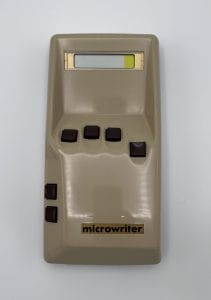
Long before laptops became light, there was the Microwriter – one of the world’s first truly portable word processors. Invented by UK-based, US-born film director and screenwriter Cy Endfield, this futuristic little device set out to reinvent typing itself.
Since 1878, we had relied on the familiar QWERTY keyword. However, Endfield had other ideas. Instead of dozens of keys, the Microwriter had just six buttons. The five finger buttons were pressed in combinations – or chords – to create every letter of the alphabet. The second thumb button acted as a mode switch letting users toggle between upper and lowercase, enter numbers, and insert punctuation. For instance, to type a letter ‘T’ the user would tap the top thumb button to shift to uppercase, then chord a ‘t’ by pressing the index finger and ring finger buttons simultaneously. It was more like playing a tiny piano than typing.
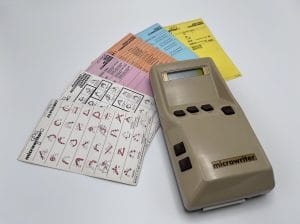
Microwriter with instruction cards. (53.1999/1).
To help users learn, the Microwriter came with flashcards featuring mnemonics for every character. The manufacturers claimed that most people could learn it in just a few hours – and once mastered, it could be 1.5 times faster than handwriting.
With practice, users could type quickly as long as they were entering plain text. Typing was a lot slower if users had to constantly shift between modes to insert special characters. This made the Microwriter useful for focused writing, but not when more complex formatting was required.
This Microwriter belonged to a Weybridge resident. They had purchased it through the ‘New Scientist’ journal and used it to write a book on their family history while travelling. In an era before laptops were practical travel companions, this pocket-sized device offered something different.
Despite having few direct competitors, production ceased in 1985. It is likely that the concept of a chording keyboard put off many potential consumers.