Explore the latest news and find out what's on this month
Explore our learning offer for schools, families and community groups
Uncover the rich history of Elmbridge with our latest online exhibitions
Want to discover more about your local area?
Explore the latest news and find out what's on this month
Explore our learning offer for schools, families and community groups
Uncover the rich history of Elmbridge with our latest online exhibitions
Want to discover more about your local area?
2018 was the centenary of (some) women gaining the vote. That’s when I first heard about the remarkable Miss Martineau (1869-1958) who lived at ‘Littleworth’ in Esher.
I discovered that Mildred, Milly to her friends, was the secretary of the Esher and East Molesey branch of the London Society of the National Union of Women’s Suffrage Societies (NUWSS).
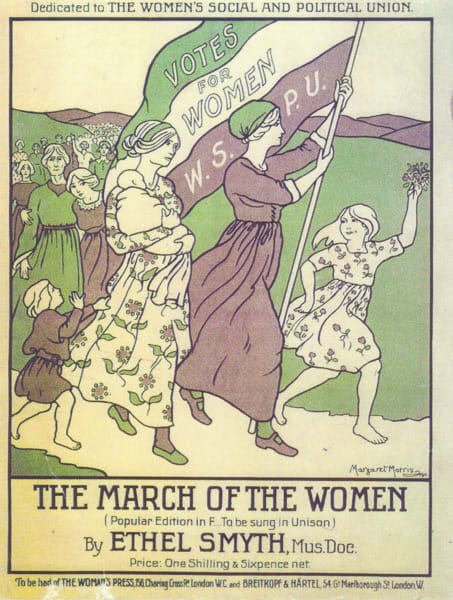
Front cover of Ethel Smyth’s composition The March of the Women, dedicated to the Women’s Social and Political Union, 1911 (Surrey History Centre reference 9180/9/5)
Between 1906 and 1914 the Women’s Social and Political Union (WSPU) – more famously known as the Suffragettes – grabbed all the headlines as they broke windows and started fires to demand the right to vote. Founded in Manchester by Emmeline Pankhurst, the Suffragettes were militant and believed in using radical, direct action.
While the WSPU raised the profile of the suffrage movement, many women and men did not believe in breaking the law for the cause. These were the Suffragists and belonged to the National Union of Women’s Suffrage Societies (NUWSS). Their campaign started 50 years earlier, and they were equally important.
Led by Millicent Fawcett, the Suffragists were law abiding citizens and protested through peaceful means – lobbying parliament, marching calmly, organising petitions, and holding public meetings.
By 1914, the NUWSS had over 500 branches and over 100,000 members. One of these was Miss Martineau.

Aside from her name and link to the Esher NUWSS, I didn’t know much more about Miss Martineau, so I started my research by asking myself, “What more had been written about her?”
Very little as it turned out as most of the information about Miss Martineau is still hidden away in places such as the Women’s Library at LSE and the British Newspaper Archive.
I found snippets of information about Mildred Martineau in the local studies library at Elmbridge Museum. However, most of what’s in the Museum’s collection focuses on the activities of the Suffragettes not the Suffragists. Their law-breaking deeds dominate the popular narrative of how the vote was won.

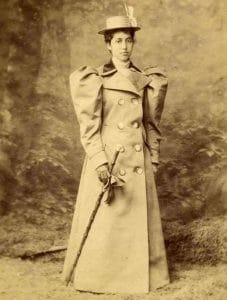
Princess Sophia Duleep Singh in 1895 (Norfolk Museum Collections)

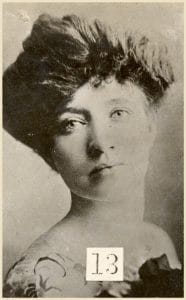
Criminal Record Office photograph of Kitty Marion
Recent biographies have reappraised the reputations of two Suffragette activists linked to our area. Anita Anand’s biography tells the story of Princess Sophia Duleep Singh, Queen Victoria’s goddaughter, who lived in a grace and favour apartment at Hampton Court Palace.
She sold copies of ‘The Suffragette’ outside the Palace and spoiled her census return by scrawling ‘No Vote, No Census’ across it. Her relationship to the Queen put the authorities in a tricky position.
Fern Riddell’s biography of Kitty Marion, a music hall artiste, tells how she and Clara Giveen set fire to the Grandstand at Hurst Park Racecourse in the early hours of Monday 9 June 1913. The Directors brushed aside the attack and erected temporary stands at a cost of £779 to enable the July race meeting to take place.
During her career as a Suffragette, Kitty was imprisoned seven times and force-fed 232 times while on hunger strike.
Princess Sophia Duleep Singh refused to fill out the 1911 Census.
Photograph of the remains of the Hurst Park Racecourse Grandstand after a fire in June 1913 started by Kitty Marion.
My research into the life of Mildred Martineau is still continuing. What I have found out so far is that she was adventurous, cultured and politically savvy. She came from a high-achieving family and was related to Harriet Martineau, the social reformer, who was herself a hero of the suffrage movement.

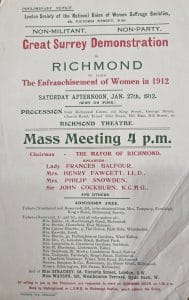
Poster for the ‘monster rally’ of the Surrey Suffrage Societies which took place in Richmond on Saturday 27th January 1912. Mildred Martineau participated in the event.
In 1908, Mildred achieved her dream of visiting Japan accompanied by two female friends. On her return, she immersed herself in the Suffragist campaign, speaking at meetings, raising funds and participating in rallies.
Mildred was among the 23 demonstrators who participated in the ‘monster rally’ in Richmond of the Surrey Suffrage Societies in January 1912.
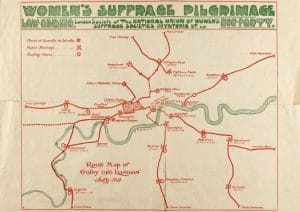
The following year, she organised the reception for 60 pilgrims marching to London for the Great Pilgrimage. On the evening of July 23rd, a crowd of close to 600 people assembled on Esher Green to greet the pilgrims.
During the First World War she kept the branch going and supported issues such as help for Belgian refugees. After the War she gave talks on Celtic literature to Claygate Literary Society and was an influential figure in the campaign to build King George’s Hall (now Esher Theatre) for the local community.

Suffragist supporters marched to London from all around the country in the Great Pilgrimage of 1913. Women from Bournemouth and Portsmouth joined together at Guildford before passing through Cobham, Esher and Kingston.
In a recent talk to the British Association for Local History, Mike Esbester of the University of Portsmouth remarked that “local stories have national implications when you scale them up”. This is why the role and contribution of women like Mildred Martineau in Esher and East Molesey is so important. I believe these local stories will lead to a more nuanced interpretation of how the Suffragist movement earned women their place in the public sphere and how their patient investment in education and organisation paid dividends in the longer term.
Anthony Barnes, Museum Volunteer
Interested in learning more about the Women's Suffrage Movement?