There are thousands of photographs in the museum’s collection, many of which focus on the landscapes around Elmbridge. They are an endlessly fascinating study of how the landscape around us is constantly changing.
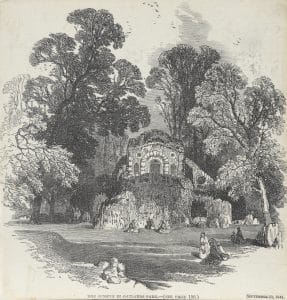
Some of the most intriguing images in our collection centre around Oatlands Grotto. Built on the banks of an artificial lake, this mystical building would overlook the expansive gardens of the Oatlands Estate for almost 200 years.
Black and white print of ‘The Grotto in Oatlands Park’, showing the Grotto without its lake. (238.1964)
The grotto was originally part of Oatlands Park, a sprawling estate that once encompassed much of Weybridge. The original structure was commissioned in the 1760s by Henry Clinton, Duke of Newcastle. Henry laid out the formal gardens, and no 18th century garden was complete without an artificial grotto. Inspired by their French and Italian counterparts, these grottos took pride of place in landscaped gardens across Britain.
The original design for the grotto was created by Stephen Wright, a respected architect. The plan shows perfectly symmetrical structure, with the grand second floor finished in the Palladian style. Work began on the structure in 1762, but ground to a halt in 1767 before decorations on the interior had begun.
Work on the grotto would resume in 1774, but the building would now be taken in a different direction. Taking its lead from the newly popularised Rococo style, a stunning shell grotto began to take shape. With the help of Joseph Lane and his son, two expert grotto builders from Tisbury in Wiltshire, a new design began to take shape. Instead of symmetrical rooms, a complex series of interlinked caverns wove through the lower floors of the building. On the first floor, the Grecian finish was replaced by stalactites and scales of felspar. Throughout, shells were used to create complex design and patterns.
The interior would have been something to behold. In contrast with the rustic backdrop, chandeliers hung from the ceiling illuminating the coral and fossils embedded into the walls. Mirrors would have reflected the light and a small pool outside the grotto had been specially created for swans.
As well as looking beautiful, the grotto was designed to be an escape for the owners of the house. One of the lower rooms housed a bath fed by water from a nearby stream, while the other functioned as a games room. The upper room could only be accessed by a set of shallow steps from outside, and was an entertaining space. This was a favoured space of the Duke and Duchess of York, who later took ownership of Oatlands House and its estate. The Duchess would frequently have her lunch served in the upper chamber, and the Duke entertained a number of influential guests there, including an Emperor of Russia.
Unfortunately, the grotto’s heyday did not last long. Over time the artificial lake dried up, and the building fell into a state of disrepair. In the 1945 the building was declared unsafe and, despite the pleas of many local residents, was demolished.
The destruction of this historic building was not all in vain however. Its loss spurred on legislation to create a list of buildings of historical importance, and the grotto at Oatlands was mentioned during parliamentary debates on this issue. Although it came too late for this majestic building, the legacy of Oatlands grotto will have saved many other buildings from a similar fate.