Explore the latest news and find out what's on this month
Explore our learning offer for schools, families and community groups
Uncover the rich history of Elmbridge with our latest online exhibitions
Want to discover more about your local area?

Explore the latest news and find out what's on this month
Explore our learning offer for schools, families and community groups
Uncover the rich history of Elmbridge with our latest online exhibitions
Want to discover more about your local area?


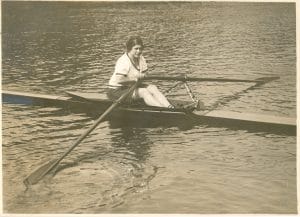
Amy Gentry on the riverbank with rowing sculls (230.1979/15).
Amy Gentry was a pioneer of women’s rowing in Britain, establishing the Weybridge Ladies Amateur Rowing Club (WLARC) in 1926. She was also one of the sport’s most accomplished competitors. Amy became the British singles sculls champion in 1932, 1933, and 1934 – retiring undefeated.
But who was the woman beyond the boathouse? Her personal possessions, kindly donated to the museum, paint a picture of a woman with many and diverse hobbies.
This blog post supported a centenary exhibition that was on display at Weybridge Library.
By the 1930s, women’s rowing had transitioned from a recreational pastime to an organised, competitive sport. The onset of the Second World War paused this growing momentum. However, Amy found another way to continue participating in the sport that she loved.
By this time Amy was working for the Vickers-Armstrong Company in Weybridge. Since 1918, Vickers-Armstrong had been producing both military and civilian aircraft. By 1935 they were the third largest manufacturing employer in Britain. The aircraft factories became vital to the war effort.

Amy Gentry in a single scull facing right (24.1998/1).
Between 1941 and 1943 she worked as the private secretary to Sir Barnes Wallis. Amy assisted him with his plans to develop a bomb that could skip across water. He had developed the idea by experimenting with bouncing marbles across a water tub in his back garden. Wallis thought that this new weapon could be used to attack moored battleships.
However, Amy’s role went far beyond office work. She frequently accompanied Wallis during his experiments at Silvermere Lake. Here he tested wooden models by catapulting them across the water. Once the experiments were over, Amy would row out to retrieve the models. This was where Amy took command as she would skilfully manoeuvre the boat to ensure that the pair did not capsize.
These experiments led to the creation of the bouncing bomb. This was a cylindrical, spinning bomb designed to skip across water, avoid anti-torpedo nets, and sink against the dam wall to explode at depth. It was used in the RAF’s Operation Chastise of May 1943 to bounce into German dams that were vital to their industry.
Amy Gentry
Amy’s time at Vickers-Armstrong also gave her the opportunity to pursue another of her talents. Amy was a gifted contralto singer with a passion for performance. Her talent earned her a gold medal at the Richmond and Twickenham Music Festival in both 1935 and 1938.
Amy Gentry's Southern Area Musical Festival 1st prize award, 1926 (290.1977/1).
Twickenham and Richmond Music Festival award. Presented to Amy Gentry in 1934 for her singing (290.1977/2).
In 1946, Amy and several of her fellow rowers helped establish the Desborough Players. This was an amateur dramatic society based in Weybridge.

Amy Gentry in stage costume as a Dutch girl (290.1976/38).

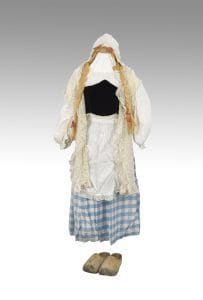
Amy’s dutch girl stage costume. She wore this while singing “Little Baggy Breeches”, a song about a Dutch boy. Her accompanist was Peggy Millson (290.1976/39).
Created by members of WLARC, the society originally staged productions during the winter months. This kept members active when off the river. Their lively performances featured old time variety musicals.
Amy delighted audiences with songs such as ‘Don’t Dilly Dally’, ‘Mr Baggy Britches’, and ‘Down by the Riverside’.

Amy’s clogs to pair with her dutch girl stage costume. She wore this while singing “Little Baggy Breeches”, a song about a Dutch boy (290.1976/39i).
Take a look at a review of one of Amy’s memorable performances.
During the war years, the society also brought entertainment to army headquarters. Their joyous and heartfelt performances offered moments of escapism during difficult times.
The society was originally formed of women. However, it has since evolved into a mixed theatre group for all the ages.
Today the Desborough Players continue to perform at the Cecil Hepworth Playhouse in Walton.
Their productions and Christmas pantomimes remain a cherished part of the local community.
Learn more about The Desborough Players
Weybridge Ladies with a visiting team form a ‘Chorus Line’. Amy Gentry is standing two in from the right (230.1979/28).
After the Second World War, Amy went back to the cause of promoting women’s rowing once again.
Read more about Amy’s her continued work and legacy in our online exhibition.

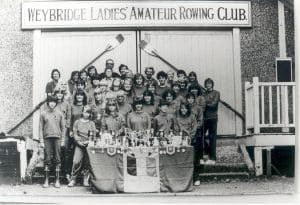
Weybridge Ladies Amateur Rowing Club Juniors with a display of their trophies, 1970s (270.1986/21).