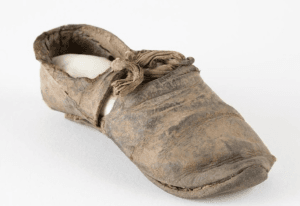
This well-worn leather child’s shoe was found in 1985 hidden behind an inglenook fireplace at Chatsby Cottage, 68 West End Lane, Esher. Although this Grade II listed cottage was built in 1742, the date of construction does not indicate the age of the shoe – unless it was buried under the foundations.
During the medieval period (5th to 15th century), the parish of Esher was divided into three manors. These were Sandon, Esher Waterville and Esher Episcopi. The lands of these manors met at the junction of the main London to Portsmouth Road. Around the time that Chatsby Cottage was built, this large common land was enclosed. This became the centre of Esher village. Esher grew to become a principal coach stop. The road was turnpiked in 1749, and by the 18th century, there were several inns serving the needs of travellers. Once of these was The Bear, which still survives and functions.
Why was the shoe hidden?
Many shoes were concealed in houses during this period of enclosure and growth.
Child’s shoe (14.1998/5)
Unfortunately, few written records survive to explain why people concealed shoes. However, several reasons have been put forward by historians. The most prevalent concerns the superstitious belief. In rural and agricultural communities, people believed that a concealed shoe would protect the household from evil spirits. Chimneys were easy ways to gain entry to a house so became popular hiding places for footwear. It was believed that the evil spirit would become attracted to the shoe and get trapped inside it. Shoes were suitable because they were moulded to the shape of an individual’s foot and imprinted with the character of the wearer.
Warding off evil might have been the original meaning of hiding shoes. However, this was later adapted to being a symbol of protection and good luck. In the case of a child’s shoe, this was seen as a fertility symbol. Others have suggested that concealed shoes were the equivalent of a time capsule. Or, that the builders hid the footwear. As they carried out the work, they may have left the shoe as a lucky charm or to confuse future generations.
We may never know who wore this child’s shoe found in Esher, or who placed it behind the fireplace. However, we do know that it is part of a much wider pattern of hiding special objects within buildings. They brought protection and comfort to the people who called these houses their home.